When I first started thinking seriously about the impact of artificial intelligence on self-storage marketing in early 2025, the question seemed relatively straightforward: could tools such as ChatGPT eventually challenge Google Search as the place where customers begin looking for a product or service?
I explored that question in an earlier article, AI and the Future of Digital Marketing. At the time, much of the discussion was necessarily speculative. AI assistants were developing remarkably quickly, but Google Search remained the obvious reference point for local customer acquisition, and it was difficult to know whether consumers would actually change the way they looked for services such as self-storage.
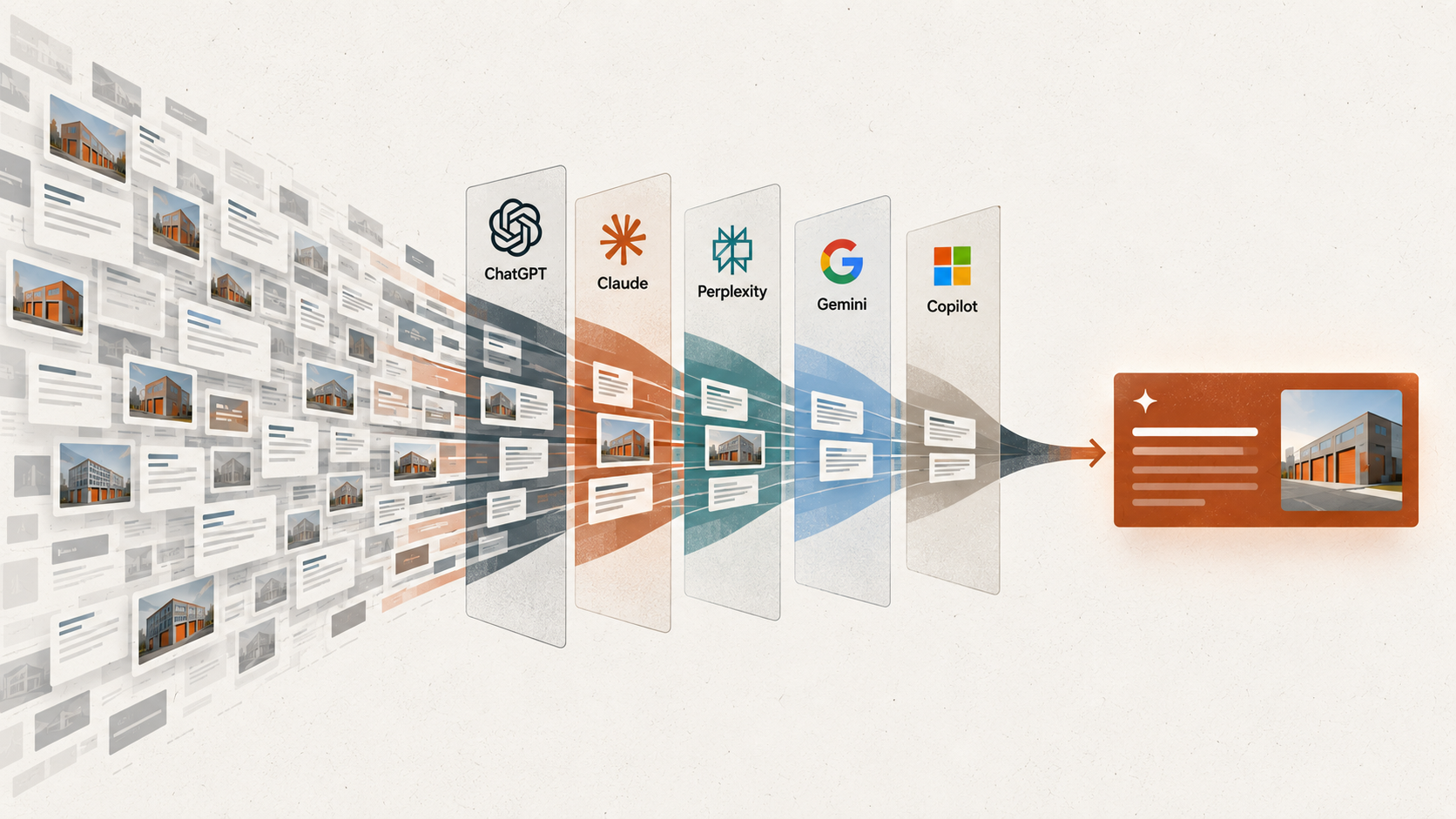
A year and a half later, the question already feels slightly outdated. Not because Google Search is disappearing — Google says Search queries reached an all-time high in early 2026 — but because the distinction between search and AI is becoming increasingly blurred. Google itself is moving rapidly into conversational search through AI Mode, which has surpassed one billion monthly users, while ChatGPT, Gemini, Claude, Copilot and Perplexity increasingly function as search, discovery and recommendation tools.
Perhaps the question, therefore, is no longer whether AI will replace Google Search. A more useful one for operators is: what changes when customers increasingly describe their problem to an AI and ask it what they should do?
A different way of discovering self-storage
The traditional online journey for a self-storage customer is familiar. Someone develops a need, searches Google Search for something like self storage Barcelona or trasteros cerca de mí, and is presented with paid listings, Maps results and organic links. The customer then does much of the work: opening websites, comparing locations, looking at reviews, checking prices and eventually contacting one or more operators.
Most digital self-storage marketing has understandably been designed around that journey. Operators compete through SEO, paid search, Google Business Profiles, reviews and increasingly sophisticated websites, all with the objective of being visible at the moment the customer searches for the product.
Conversational AI introduces a rather different process. A prospective customer can instead explain that they are renovating an 80 m² apartment for four months, need somewhere for the furniture, expect to visit only twice and will be using a van. The AI can interpret those requirements, suggest an appropriate unit size, decide that loading access matters more than proximity, compare facilities and recommend a handful of operators.
The important difference is not simply that the customer used ChatGPT rather than Google Search. It is that part of the comparison has taken place before the customer reaches an operator’s website.
With conventional search, being fourth, sixth or even eighth still means appearing among the alternatives that the customer can investigate. With an AI-generated answer, the initial consideration set may contain only two or three operators.
That raises a rather different marketing question. It may become less about where do I rank? and increasingly about whether my facility enters the AI’s consideration set in the first place.
Rather than speculate, I decided to test it
I wanted to see whether this distinction was actually visible in practice, so I ran a small experiment using five of the major AI assistants: ChatGPT, Claude, Gemini, Microsoft Copilot and Perplexity.
I gave each system the same series of realistic customer enquiries across Madrid and Barcelona. We tested eight different scenarios, producing 40 individual responses. The questions started relatively broadly and then introduced increasingly specific requirements around location, unit size, security, vehicle access, opening hours and business use.
One scenario involved an online retailer needing 10–15 m² for stock with regular access. Another concerned valuable furniture that would be stored for a year, with security more important than price. We asked about an apartment renovation, about late-evening access with a van and, finally, described a moving problem without mentioning self-storage at all.
This was an exploratory exercise, not a statistically representative study. Forty AI responses cannot tell us how millions of future customer enquiries will behave, and the systems themselves are changing constantly. I am preparing the complete results separately because they deserve a more systematic analysis.
Nevertheless, some patterns were sufficiently consistent to be useful.
There is no single “AI ranking”
One of the clearest findings was that the systems did not simply reproduce the same list of large operators in a slightly different order.
There was certainly some concentration. Bluespace appeared frequently, particularly in Madrid, while OhMyBox was particularly prominent in Barcelona. Large operators have obvious advantages: multiple facilities, substantial websites, many customer reviews and a much larger volume of information about them distributed across the web.
But brand strength alone did not explain the results. Recommendations changed materially as the customer’s circumstances changed.
When vehicle access and loading became important, facilities with documented parking, loading bays or drive-in access began appearing. When security became the priority, the systems started comparing CCTV, individual alarms, fire protection and insurance, and some concluded that a conventional guardamuebles service might actually be preferable to self-storage. When the customer became an e-commerce business, delivery reception, loading facilities, flexible unit sizes and business-specific services became much more important.
Smaller operators also appeared ahead of larger competitors when their characteristics matched a particular enquiry particularly well.
Our experiment therefore suggests that AI visibility may be considerably more contextual than a conventional search ranking. There may be no meaningful equivalent of being permanently “number one on ChatGPT for self-storage Barcelona”. The answer depends heavily on the question being asked.
Giving AI something it can understand
Another pattern appeared repeatedly: the more explicitly an operator described what a facility actually offered, the easier it was for the AI systems to explain why that facility matched a particular customer.
There is a significant difference, for example, between saying that a facility offers secure, flexible storage with convenient access and explaining that customers can access their units from 07:00 to 22:00 every day, that 24-hour access can be activated separately, that vans can enter a dedicated loading area and that trolleys and a goods lift are available.
The first description may sound perfectly acceptable as marketing copy, but it contains very little that distinguishes one facility from another. The second contains facts that can be matched directly against a customer’s requirements.
We saw this particularly clearly with access hours. Several systems confused 24/7 surveillance with 24/7 customer access, while “365-day access” was sometimes interpreted as unrestricted access at any hour. Those are quite different things, but vague or inconsistent information makes the distinction difficult for both customers and machines.
The practical lesson is not especially complicated: don’t make the AI guess. Publish actual access hours, explain whether 24-hour access is available, describe the loading arrangements, specify unit sizes, state whether vans can enter, explain the security systems and make clear whether staff can receive deliveries.
In our tests at least, specific facts gave the systems considerably more to reason with than generic marketing claims.
The facility matters, not just the brand
This also reinforces the importance of facility-level information.
A customer rarely needs “Bluespace Barcelona” or “OhMyBox Barcelona” in the abstract. They may need a facility in Sant Andreu that allows a van to enter after 8 p.m., or one in Eixample that can accept deliveries while they are away.
For a multi-site operator, each facility therefore needs to function as a distinct digital entity. Its page should clearly establish where it is, when customers can access it, what unit sizes are available, how loading works, what security is provided and what differentiates that particular location.
Customer reviews may contribute to this understanding as well. In several of our tests, AI systems drew on reviews to infer practical characteristics such as ease of loading, parking, staff helpfulness and the general experience of using a facility.
Reviews have traditionally been viewed primarily as social proof for prospective customers and as an important component of local search. They may now have another function: providing AI systems with independent evidence about what a facility is actually like.
From describing the product to understanding the customer’s situation
The business-storage test produced another interesting pattern.
When we asked where a small online retailer should keep 10–15 m² of inventory with regular access, the systems did not simply look for facilities offering units of the correct size. They considered whether suppliers could deliver directly to the site, whether stock could be accessed frequently, how easy loading would be and whether the customer could expand into a larger unit as the business grew.
Operators that had dedicated pages explaining their e-commerce or business-storage proposition gave the AI considerably more context with which to work.
This made me reconsider the role of what we normally call “use-case content”. Pages about moving home, renovations, business stock, e-commerce, downsizing or temporary relocation are not simply additional SEO content. They explain the circumstances in which self-storage becomes useful.
And those circumstances are important because they are where demand actually begins.
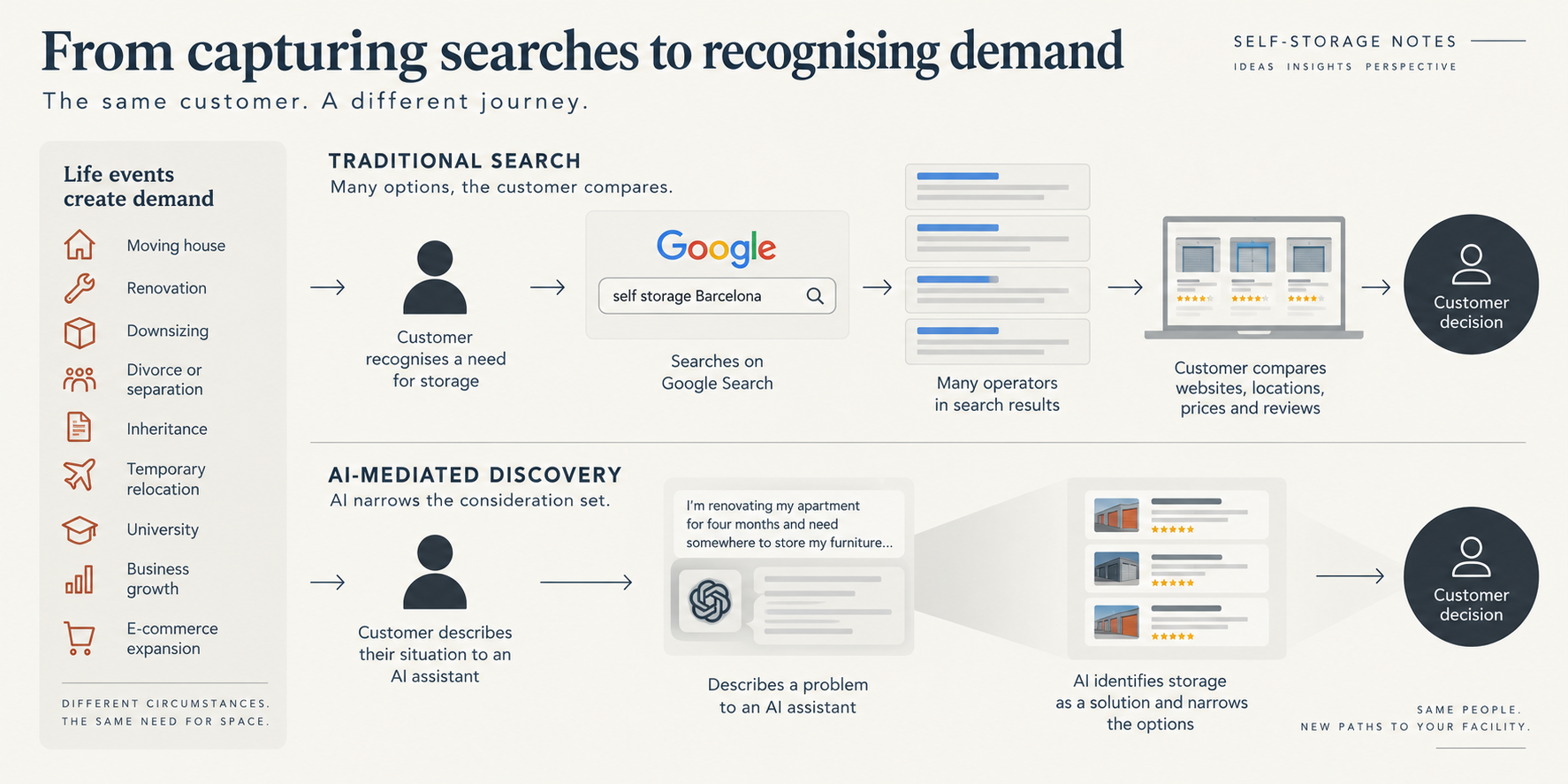
The distinction may look subtle, but from a marketing perspective it is significant. Traditional digital marketing has largely concentrated on capturing demand once the customer has identified the product. Conversational AI has the potential to recognise the underlying demand before the customer has reached that point.
Our final experiment illustrated this particularly well.
What if the customer never mentions self-storage?
For the eighth test, we deliberately removed any reference to storage from the question.
We simply described someone leaving an apartment in Barcelona whose next home would not be ready for five months. They had furniture and around 30 boxes and wanted to know what they should do with them.
All five AI assistants identified storage as the solution.
More interestingly, several went beyond recommending the nearest conventional self-storage facility. Perplexity and Claude reasoned that, because the customer probably would not need regular access during the five-month period, a managed guardamuebles service that collected the furniture and returned it when the new home was ready might actually be more appropriate. Other systems presented conventional self-storage and collection-and-delivery storage as alternatives.
This was probably the most interesting result of the experiment because the customer had never identified themselves as a self-storage customer.
The AI had done that for them.
Self-storage demand has always been driven by events rather than by an inherent desire to rent a storage unit. People move home, renovate, inherit furniture, relocate temporarily or run out of space. Businesses accumulate stock. Online retailers outgrow spare bedrooms.
Until now, digital marketing has largely waited for those circumstances to translate into a recognisable search for our product. AI potentially allows self-storage to enter the conversation one stage earlier, while the customer is still describing the underlying problem.
That creates an opportunity that goes beyond ranking for self storage near me. An operator increasingly needs to make it possible for a machine to understand which customer problems its facilities are particularly well suited to solve.
AI can understand the problem — and still get the answer wrong
There was another side to our results, and it would be dangerous to ignore it.
The systems made a surprising number of factual errors. One recommended a major European self-storage company in a city where the operator apparently had no facilities. Another repeatedly presented luggage-locker businesses as suitable alternatives to conventional self-storage. One unit-size recommendation appeared to import American sizing guidance into the Spanish market and consequently suggested considerably more space than the other systems.
We also found reception hours being confused with customer access hours, 24-hour surveillance apparently interpreted as 24-hour access, and claims about climate control or other facility characteristics that were difficult to substantiate.
These weren’t all failures of reasoning. In several cases, the AI understood the customer’s problem perfectly well but retrieved, interpreted or combined the underlying business information incorrectly.
That distinction matters. AI can understand what a customer needs and still recommend the wrong facility.
For consumers, that is a reason to continue verifying important information before making a decision. For operators, however, it reinforces the importance of maintaining accurate and consistent information across their own websites, Google Business Profiles, directories and other sources.
If one source says customers have 24-hour access and another says 07:00–22:00, the machine has to decide which one to believe. If an operator is poorly classified online, it may be grouped with luggage storage, removals or warehousing businesses that offer a fundamentally different service.
Accuracy and consistency are therefore becoming part of AI visibility.
This is not the death of Google Search — or SEO
It would be tempting to turn all of this into another prediction that AI will kill Google Search. I don’t think the evidence supports that conclusion.
Google Search remains enormous and Google says overall Search activity continues to grow even as AI Mode expands. The distinction we need to make is therefore not simply between “Google” and “AI”, but between the traditional Google Search journey and a broader form of AI-mediated discovery that now includes Google’s own AI Mode.
Nor does any of this make SEO obsolete. AI assistants still depend heavily on information available on the web: operator websites, local listings, customer reviews, directories, media coverage and other sources. Good technical SEO, local SEO and a well-structured website arguably become more important when those same assets need to be understood not only by prospective customers and conventional search engines, but also by AI systems assembling an answer.
Advertising is moving in the same direction. In August 2026, OpenAI expanded ChatGPT Ads to 31 European markets, including Spain, with self-service access through Ads Manager following across those markets at the end of the month. Google is also integrating advertising into its AI-generated search experiences. The idea that conversational AI would simply eliminate paid search now looks increasingly unlikely. Advertising appears more likely to follow the customer into whichever interface they use.
The channels are converging rather than one simply replacing another.
What should operators do now?
I would be wary of reacting to this by commissioning an entirely new “AI optimisation strategy” or becoming too concerned with the growing collection of acronyms such as GEO and AEO. Most of the practical lessons from our experiment are much less exotic and, reassuringly, much of what makes a facility easier for AI to understand also makes it easier for customers to understand.
I would start with six things:
- Make every facility independently understandable online. Give each location a detailed page containing its address, access arrangements, available sizes, loading facilities, parking, security and relevant services rather than treating it simply as an address on a corporate locations page.
- Replace vague claims with explicit facts. “Convenient access” is much less useful than actual opening hours. “Excellent security” is less informative than explaining the CCTV, access-control, alarm and fire-protection systems. If 24-hour customer access differs from 24-hour surveillance, say so clearly.
- Write about the situations that create storage demand. Explain how your service works for someone moving between homes, renovating, downsizing, relocating abroad, managing e-commerce inventory or running a business that has outgrown its stock space. These are not merely content topics; they are the circumstances from which demand originates.
- Keep the information consistent across the web. Your website, Google Business Profile, Maps listings, directories and other third-party sources should not contradict one another on opening hours, services, addresses or facility characteristics.
- Continue investing in genuine customer reviews. Reviews remain important for human trust and local search, but our experiment suggests they can also help AI systems understand practical aspects of the facility that aren’t always obvious from corporate descriptions.
- Test the AI assistants yourself. Don’t simply ask “What is the best self-storage company in Barcelona?” Ask the questions your customers might actually ask. Describe a renovation, an e-commerce business or a need to store valuable furniture for a year. Change the neighbourhood, access requirements and priorities, and observe not only whether your facility appears but what the AI believes to be true about it.
None of this requires abandoning traditional digital marketing. Most of it is good SEO and good customer communication anyway.
The difference is that your website increasingly has another reader: the machine helping your prospective customer decide what to do.
Being found before someone searches for you
When I first considered whether AI might challenge Google Search as the starting point for self-storage discovery, I was mainly thinking about what would happen to search traffic.
After running this experiment, I think that framing is too narrow.
The more interesting development is not simply that somebody might ask ChatGPT instead of typing a query into Google Search. It is that they may describe a situation without knowing what product they need at all.
An AI can interpret that situation, identify self-storage as one possible solution, decide what characteristics matter and potentially reduce an entire local market to a shortlist of two or three facilities before the customer has visited a single operator website.
There are obvious limitations while the technology remains capable of making factual mistakes, and it would be premature to know how quickly consumer behaviour will change. Google Search will remain an essential acquisition channel for the foreseeable future.
But the direction is worth paying attention to.
For years, self-storage operators have worked hard to be found when somebody searches for self-storage. Increasingly, we may also need to make sure we can be found before they know that self-storage is what they are looking for.